#28

#28
Case Study: Muratec’s Proposal Overcomes
Labor Reduction Challenges
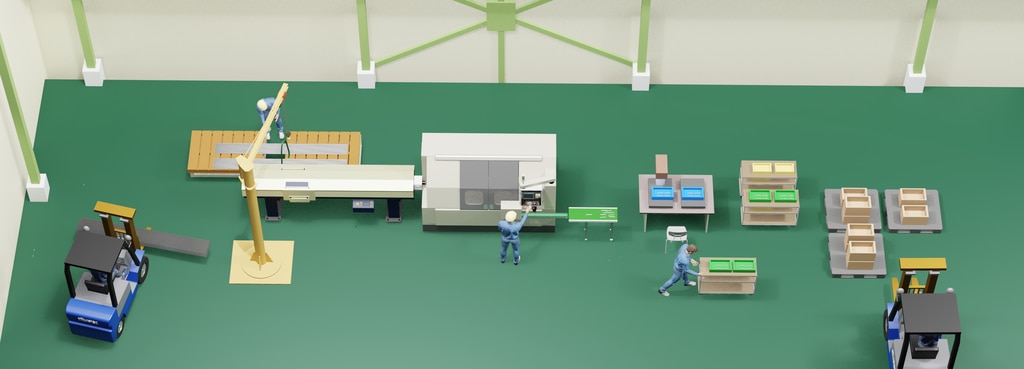
Challenges

Material stock capacity was insufficient, requiring operators to attend to the machines frequently. Under these conditions, operating 24 hours a day was simply not feasible.
Points of the problem faced by the customer
In this case, each stage of the process presented its own challenges, requiring solutions to be considered from multiple perspectives.
① Pre-processing: Material Loading
While the customer had been machining complex shaft workpieces entirely from bar stock, the bar feeder's limited storage capacity created a major bottleneck. With insufficient material storage for continuous 24-hour operation, a new loading approach was needed.
② During Processing: Tool Change Operations
Blade wear requires operators to routinely inspect the cutting edges and replace them to maintain consistent performance.
③ Post-Processing: Quality Check / Finished Product Sorting
Finished parts were discharged at a cycle time of approximately 10 minutes per piece, necessitating periodic manual quality checks by operators.
After inspection, the workpieces were placed on a belt conveyor and discharged sequentially. Boxing and sorting operations were then carried out manually.
Solutions
We combined our technology and products to address the customer’s challenges and made the following proposals.
(1) Change of material stocker
By switching from bar material to cut-off stock and selecting our own shaft work stocker as the feed-in unit, we developed a system capable of reliably stocking materials for 24 hours of continuous operation. Although this approach requires a preliminary bar-cutting step, the subsequent operation is simple, as the cut stock can be easily rolled in and fed into the unit. We adopted this method from a comprehensive perspective, as it not only increased storage capacity compared to using a bar feeder, but also improved workability and safety.
② Utilization of spare cutting tools
Since the wear and tear of blades is unavoidable, we changed the operation to automatically monitor the condition of the cutting tools using a “tool life management function.” When a tool reaches a certain amount of use, the “auto tool shift function” automatically switches to a spare tool mounted at a different station, enabling processing to resume with a new tool without stopping the machine.
③ Automation of Quality Inspection and Finished Product Sorting
For quality inspection, we proposed our automated measuring system.
With numerous measurement points, manual inspection—including data inputting on PC—took approximately 4-5 minutes per piece. But this system eliminated their manpower entirely. Furthermore, the standard “automatic dimensional correction function” eliminates the need for manual input of corrections on the machine.
For finished product sorting, we proposed our new unit, the “Tray Feeder.” The loader sequentially places and aligns workpieces within trays, allowing operators to ship workpieces directly from the trays into boxes.

Figure: For your clear image, safety covers are removed in this figure.
How did it work to the customer?
We achieved 24-hour operation, meeting the capital investment requirements while also improving the customer’s on-site operations.
Production is now possible with virtually unmanned operation, excluding machine maintenance and consumable replacement tasks. The customer praised the system as “a setup that can keep running without a man.”
Many machine manufacturers and companies focus on hardware solutions, combining the right options to reduce labor on the shop floor. However, as demonstrated in this case, careful consideration of the operational aspects of each unit is essential to ensure the system functions according to the customer’s vision.
This project became a best-case scenario, where our expertise in providing one-stop solutions perfectly matched the customer's needs, delivering substantial results.
If you have any questions, please contact us here
RELATION
Related page

CONTACT
If you are considering automated production,
please contact Muratec.
If you have any questions, please contact us here