#31

#31
【One idea for fixing workpiece orientation】
Try it with the C-axis torque skip function!
Challenges
Points of the problem faced by the customer
“Manual handling leads to inconsistent quality, and above all, it increases workload and labor burden. We also want to avoid adding large-scale units or functions whenever possible...”
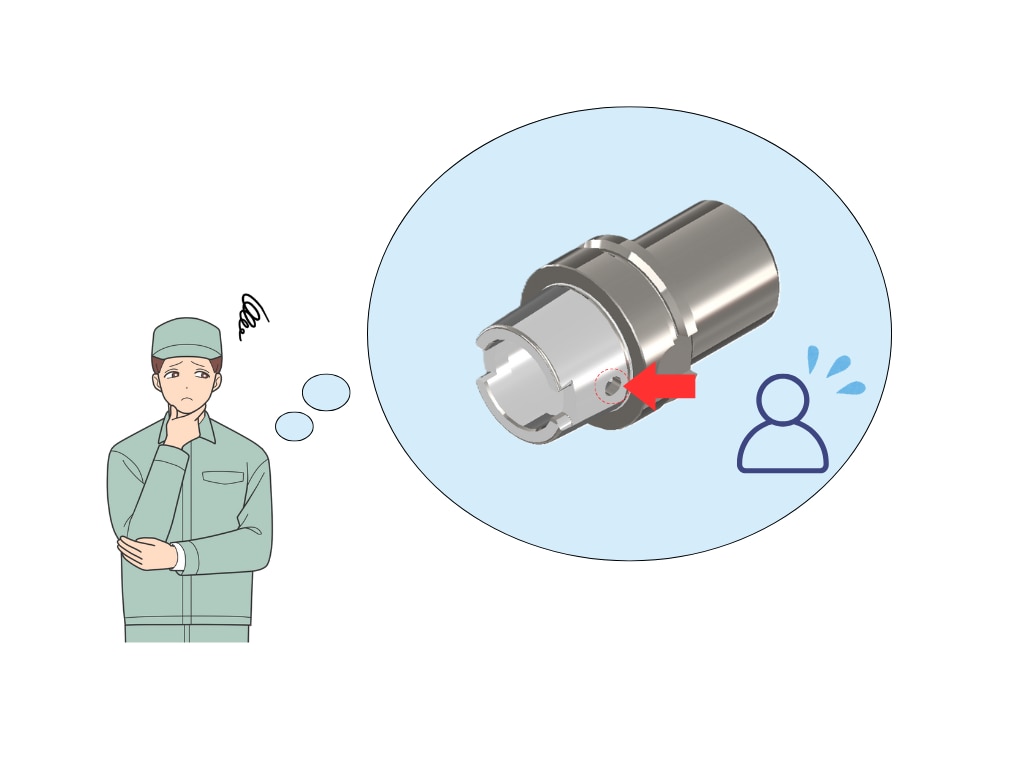
When machining the workpiece, drill holes into the side surfaces in the same orientation as the grooves on the end faces. To do this, the workpiece's orientation must be determined and fixed beforehand.
However, the customer was struggling because they couldn't come up with an optimal way to determine it.
Solutions
We proposed “pre-machining positioning utilizing the C-axis torque skip function” to address their concerns.
While orientation determination is typically achieved using peripheral units or in-machine measurement tools, it can also be accomplished simply by combining the spindle's C-axis function with a test bar.
This time, we implemented an operation where a test bar is mounted on the turret tool holder, and load is detected via the C-axis.
As the C-axis rotates, the test bar contacts the groove side surface, causing a torque change.
This simple method calculates the angle and distance based on this change in torque.
How did it work to the customer?
We proposed “pre-machining positioning utilizing the C-axis torque skip function” to address their concerns.
While orientation determination is typically achieved using peripheral units or in-machine measurement tools,
it can also be accomplished simply by combining the spindle's C-axis function with a test bar.
This time, we implemented an operation where a test bar is mounted on the turret tool holder,
and load is detected via the C-axis.
As the C-axis rotates, the test bar contacts the groove side surface, causing a torque change.
This simple method calculates the angle and distance based on this change in torque.
If you have any questions, please contact us here
RELATION
Related page

CONTACT
If you are considering automated production,
please contact Muratec.
If you have any questions, please contact us here